CBSE Board Class 10 Maths Question Paper 2025
Full CBSE Class 10 Maths 2025 Question Paper with Solutions
-
If $\alpha$ and $\beta$ are the zeros of polynomial $3x^2 + 6x + k$ such that $\alpha + \beta + \alpha\beta = -\frac{2}{3}$, then the value of $k$ is:
- $-8$
- $8$
- $-4$
- $4$
Show solution
Sum of zeros = -b/a = -6/3 = -2, Product of zeros = c/a = k/3. Using α + β + αβ = -2/3: -2 + k/3 = -2/3 → k = 4.
-
If $x = 1$ and $y = 2$ is a solution of the pair of linear equations $2x - 3y + a = 0$ and $2x + 3y - b = 0$, then :
- $a = 2b$
- $2a = b$
- $a + 2b = 0$
- $2a + b = 0$
Show solution
Putting x = 1 and y = 2 in the equations gives a = 4 and b = 8. Therefore, 2a = b.
-
The mid-point of the line segment joining the points $P(-4, 5)$ and $Q(4, 6)$ lies on:
- x-axis
- y-axis
- origin
- neither x-axis nor y-axis
Show solution
Mid-point = ((-4+4)/2, (5+6)/2) = (0, 5.5), which lies on the y-axis.
-
If $\theta$ is an acute angle and $7 + 4 sin\theta = 9$, then the value of $\theta$ is:
- $90^{\circ}$
- $30^{\circ}$
- $45^{\circ}$
- $60^{\circ}$
Show solution
7 + 4 sinθ = 9 ⇒ 4 sinθ = 2 ⇒ sinθ = 1/2. For acute angle, θ = 30°.
-
The value of $tan^2\theta - \left(\dfrac{1}{cos\theta} \times sec\theta\right)$ is:
- $1$
- $0$
- $-1$
- $2$
Show solution
Using identity sec²θ = 1 + tan²θ, tan²θ - sec²θ = tan²θ - (1 + tan²θ) = -1.
-
If $HCF(98, 28) = m$ and $LCM(98, 28) = n$, then the value of $n - 7m$ is:
- $0$
- $28$
- $98$
- $198$
Show solution
HCF = m = 14, LCM = n = 196. So, n - 7m = 196 - 98 = 98.
-
The tangents drawn at the extremities of the diameter of a circle are always:
- parallel
- perpendicular
- equal
- intersecting
Show solution
A tangent at the endpoint of a diameter is perpendicular to the radius, so two such tangents are perpendicular to each other.
-
In triangles ABC and DEF, ∠B = ∠E, ∠F = ∠C and AB = 3 DE. Then, the two triangles are:
- congruent but not similar
- congruent as well as similar
- neither congruent nor similar
- similar but not congruent
Show solution
AA similarity makes the triangles similar. But AB ≠ DE, therefore they are not congruent.
-
If $(-1)^n + (-1)^8 = 0$, then n is:
- any positive integer
- any negative integer
- any odd number
- any even number
Show solution
(-1)^8 = 1. So (-1)^n + 1 = 0 ⇒ (-1)^n = -1 which happens only when n is odd.
-
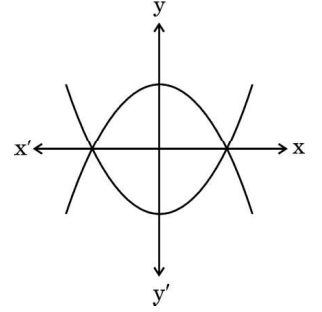
Two polynomials are shown in the graph below. The number of distinct zeroes of both the polynomials is:
- $3$
- $5$
- $2$
- $4$
Show solution
Both curves intersect the x-axis at the same two points, so there are only 2 distinct zeroes.
-
If the sum of first $m$ terms of an AP is $2m^2 + 3m$, then its second term is:
- $10$
- $9$
- $12$
- $4$
Show solution
S1 = 5, S2 = 14, so a2 = S2 - S1 = 14 - 5 = 9.
-
Mode and Mean of a data are $15x$ and $18x$, respectively. Then the median of the data is:
- $x$
- $11x$
- $17x$
- $34x$
Show solution
Using Mode = 3Median - 2Mean: 15x = 3Median - 36x → 51x = 3Median → Median = 17x.
-
A card is selected at random from a deck of $52$ playing cards. The probability of it being a red face card is:
- $\frac{3}{13}$
- $\frac{2}{13}$
- $\frac{1}{2}$
- $\frac{3}{26}$
Show solution
There are 6 red face cards out of 52 (J, Q, K of hearts & diamonds). So probability = 6/52 = 3/26.
-
Which of the following is a rational number between $\sqrt{3}$ and $\sqrt{5}$?
- 1.4142387954012....
- $2.32\bar{6}$
- π
- 1.857142
Show solution
√3 ≈ 1.732 and √5 ≈ 2.236. 1.857142 (13/7) lies between them and is rational, so option D is correct.
-
If a sector of a circle has an area of $40\pi$ sq. units and a central angle of $72^{\circ}$, the radius of the circle is:
- $200$ units
- $100$ units
- $20$ units
- $10\sqrt{2}$ units
Show solution
40π = (72°/360°)πr² ⇒ 40 = r²/5 ⇒ r² = 200 ⇒ r = 10√2.
-
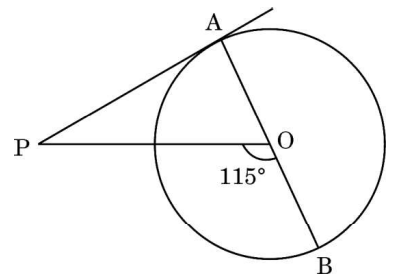
In the given figure, PA is a tangent from an external point P to a circle with centre O. If ∠POB = $115^{\circ}$, then ∠APO is equal to:
- $25^{\circ}$
- $65^{\circ}$
- $90^{\circ}$
- $35^{\circ}$
Show solution
A, O और B एक ही सीधी रेखा पर हैं, इसलिए ∠POA = 180° − 115° = 65°. चूँकि OA त्रिज्या है और PA स्पर्श रेखा, ∠OAP = 90°. त्रिभुज APO में ∠APO + 65° + 90° = 180° ⇒ ∠APO = 25°.
-
A kite is flying at a height of $150$ m from the ground. It is attached to a string inclined at an angle of $30^{\circ}$ to the horizontal. The length of the string is:
- $100\sqrt{3}$ m
- $300$ m
- $150\sqrt{2}$ m
- $150\sqrt{3}$ m
Show solution
sin 30° = 150 / L ⇒ 1/2 = 150 / L ⇒ L = 300 m.
-
A piece of wire $20$ cm long is bent into the form of an arc of a circle of radius $\frac{60}{\pi}$ cm. The angle subtended by the arc at the centre of the circle is:
- $30^{\circ}$
- $60^{\circ}$
- $90^{\circ}$
- $50^{\circ}$
Show solution
Using arc formula L = rθ ⇒ 20 = (60/π)θ ⇒ θ = π/3 = 60°.
-
Assertion (A): The probability of selecting a number at random from the numbers 1 to 20 is 1.
Reason (R): For any event E, if P(E) = 1, then E is called a sure event.- Both Assertion (A) and Reason (R) are true and Reason (R) is the correct explanation of Assertion (A).
- Both Assertion (A) and Reason (R) are true, but Reason (R) is not the correct explanation of Assertion (A).
- Assertion (A) is true, but Reason (R) is false.
- Assertion (A) is false, but Reason (R) is true.
Show solution
Selecting one number from 20 gives probability 1/20, not 1, so Assertion is false. Reason is a correct definition, so Reason is true.
-
Assertion (A): If we join two hemispheres of same radius along their bases, then we get a sphere.
Reason (R): Total Surface Area of a sphere of radius r is $3\pi r^2$.- Both Assertion (A) and Reason (R) are true and Reason (R) is the correct explanation of Assertion (A).
- Both Assertion (A) and Reason (R) are true, but Reason (R) is not the correct explanation of Assertion (A).
- Assertion (A) is true, but Reason (R) is false.
- Assertion (A) is false, but Reason (R) is true.
Show solution
Assertion (A) is true because two hemispheres of same radius form a sphere. Reason (R) is false because TSA of a sphere is 4πr², not 3πr².
-
Three numbers in AP have the sum $30$. What is its middle term?
- $4$
- $10$
- $16$
- $8$
Show solution
If the three terms are (a − d), a, (a + d), then 3a = 30 ⇒ a = 10.
-
An arc of a circle is of length $5\pi$ cm and the sector it bounds has an area of $20\pi~cm^2$. Its radius is:
- 10 cm
- 1 cm
- 5 cm
- 8 cm
Show solution
Sector area A = (1/2)rl ⇒ 20π = (1/2) r × 5π ⇒ r = 8 cm.
-
If $\alpha + \beta = 90^{\circ}$ and $\alpha=2\beta$, then $cos^2\alpha + sin^2\alpha$ is equal to:
- $0$
- $\frac{1}{2}$
- $1$
- $2$
Show solution
α = 60° and cos²60° + sin²60° = 1/4 + 3/4 = 1.
-
If the length of a chord of a circle is equal to its radius, then the angle subtended by the chord at the centre is:
- $60^{\circ}$
- $30^{\circ}$
- $120^{\circ}$
- $90^{\circ}$
Show solution
The chord and the two radii make an equilateral triangle since all sides = r. So the angle at the centre = 60°.
-
The greatest number which divides $70$ and $125$, leaving remainders $5$ and $8$ respectively, is:
- $13$
- $65$
- $875$
- $1750$
Show solution
70 − 5 = 65 and 125 − 8 = 117, so required number = gcd(65,117) = 13.
-
A ladder $14$ m long leans against a wall. If the foot of the ladder is $7$ m from the wall, then the angle of elevation of the top of the wall is:
- $15^{\circ}$
- $30^{\circ}$
- $45^{\circ}$
- $60^{\circ}$
Show solution
cos θ = 7/14 = 1/2, hence θ = 60°.
-
What is the mode of a data if median and mean of the same data are $9.6$ and $10.5$, respectively?
- $7.8$
- $12.3$
- $8.4$
- $7$
Show solution
Mode = 3Median − 2Mean = 3(9.6) − 2(10.5) = 7.8.
-
The value of $(tan A \cdot cosec A)^2 - (sin A \cdot sec A)^2$ is:
- $0$
- $1$
- $-1$
- $2$
Show solution
tan A · cosec A = sec A and sin A · sec A = tan A. So expression = sec²A − tan²A = 1.
-
The sum of the zeroes of the polynomial $p(x) = 5x - 7x^2 + 3$ is:
- $\frac{-7}{5}$
- $\frac{7}{5}$
- $\frac{5}{7}$
- $\frac{-5}{7}$
Show solution
For ax² + bx + c, sum of zeroes = -b/a = -5/(-7) = 5/7.
-
The $11^{th}$ and $13^{th}$ term of an AP are $39$ and $45$, respectively. What is the common difference of the AP?
- $42$
- $21$
- $6$
- $3$
Show solution
a + 10d = 39 and a + 12d = 45 ⇒ 2d = 6 ⇒ d = 3.
📘 Related Study Material
- 👉 Class 10 CBSE Previous Year Board Question Papers
- 👉 CBSE Board Class 10 Science Question Paper 2025
- 👉 CBSE Board Class 10 Social Science Question Paper 2025
- 👉 Class 10 Mathematics Case Study Based Questions 2025
- 👉 Class 10 Science Case Study Based Questions 2025
- 👉 Class 10 Social Science Case / Source Based Questions 2025